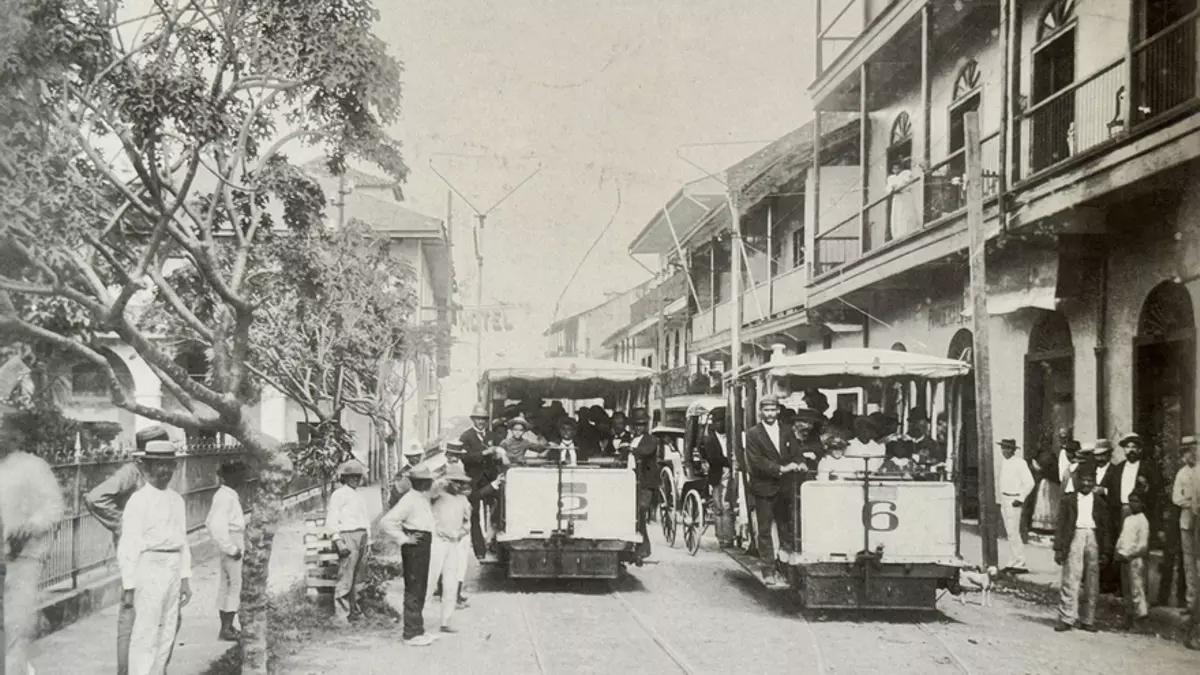
Avenida Central is the historic heart of Panama City, shaped by over 350 years of culture, commerce, and everyday life. Once the city’s main commercial corridor, it is now entering a new era of revitalization—where heritage, community, and modern urban energy come together to redefine one of Panama’s most iconic pedestrian streets.
The Long Life of Avenida Central
Avenida Central has been the working spine of Panama City for more than three hundred and fifty years. In that time it has been a colonial road, a tramway corridor, a shopping district to rival any in Central America, a pedestrian mall, a contested piece of public space, and — now — the subject of the most serious rehabilitation effort it has seen in a generation.
It has seen the Spanish Empire, the California gold rush, two world wars, and just about every important political event in the country’s history.
A Road Out of the Walls
When Panama City was refounded on its current site in 1673, after pirates and fire had rendered the first city uninhabitable, the new walled town was compact — a few blocks of stone and wood facing the Pacific. Avenida Central began, in effect, as the road out. It ran northeast from the gates of what is now Casco Antiguo, through open ground that would, over the next two centuries, fill in with the neighborhoods of Santa Ana and Calidonia.
The decisive event was the Panama Railroad. Built between 1850 and 1855 — the world's first transcontinental rail line, laid during the California gold rush — it turned Panama City from a provincial outpost into a global transshipment node, and it did so by depositing travelers and cargo at a terminus that fed directly into Avenida Central. Merchants moved in. Shops opened. By the end of the nineteenth century, Panamanians of French, Chinese, Italian, Jewish, Lebanese, and Syrian descent were trading up and down the avenue, and Avenida Central had become something more than a connector. It had become, in the phrase local historians still use, the first great shopping district of Panama City.
The Tram Years
For nearly half a century, if you wanted to go shopping in Panama City, you took the tram.
The mule-drawn line opened in 1893. The electric upgrade came in 1913. The tramway ran directly down Avenida Central, through Santa Ana and into Calidonia, carrying seamstresses and bankers and schoolchildren past the Teatro Edén, the Cine Central, Félix B. Maduro, Bazar Francés, Casa Fastlich. On weekends, the avenue was where Panamanians went to see and be seen — to walk, to window-shop, to drink coffee, to meet friends, to argue politics. The whole ritual of the weekend paseo centered on the Central.
The tram ended in 1941, dismantled under President Arnulfo Arias in favor of buses. It was a decision that looked modern at the time and, in hindsight, looks like the first hint of a pattern that would play out across the twentieth century: every generation of urban planners in the Americas has had its romance with the automobile, and the bill for that romance has always come due later.
But the avenue kept its momentum. Through the 1950s and 1960s, Avenida Central was still the street. Plaza 5 de Mayo anchored one end, Plaza Santa Ana the other. Banks, jewelers, tailors, department stores, cinemas. An entire middle-class civic life happened on foot along its length.
The Decline Is Always About Somewhere Else
Then the malls opened.
The story of Avenida Central's decline in the 1970s and 1980s is not really a story about Avenida Central. It is a story about Via España, and then Multicentro, and then Multiplaza, and finally Albrook. It is the same story that happened to Main Street in a thousand North American towns, to the high streets of Britain, to the corso of Italian provincial capitals. Middle-class consumers discovered air conditioning and structured parking and chose them. The historic core lost first its wealthier shoppers, then its confidence, and eventually some of its buildings.
In Panama, the ordinary forces of suburbanization were compounded by extraordinary ones. The Noriega years were bad for investment everywhere but especially in the historic city. The 1989 U.S. invasion left much of El Chorrillo — the neighborhood immediately adjacent to Casco Antiguo — in ashes. By the early 1990s, Avenida Central was a place where commerce continued, stubbornly, because Panamanians and their neighbors from Colombia and Venezuela still came to buy clothes and electronics. But the idea of the street as a civic asset had mostly evaporated from the minds of the people running the country.
The Pedestrianation
In 1991 the Correa administration closed a kilometer-long stretch of Avenida Central to cars, from Plaza Santa Ana to Plaza 5 de Mayo, and turned it into a pedestrian mall.
La Peatonal, as everyone calls it, was not a planning consensus. The planning literature of the early 1990s in Latin America was not full of pedestrianization advocates; the dominant idea was still that downtowns died because people could not drive through them.
For most of the next three decades, La Peatonal was the only significant pedestrian shopping street in Panama City. It did not become what its champions had hoped — the informal commerce, the physical wear, and the stigma of decline kept it from becoming a showcase — but it survived, and it kept its identity as a place where you walked. In 2007, when a subsequent municipal administration tried to reopen part of it to vehicles, merchants and residents collected signatures and stopped them. By that point, thirteen years of pedestrian use had made the street socially uncloseable. This is the sort of thing that does not show up in quarterly reports but matters enormously over a generation.
The Long Middle
The 2010s were hard on Avenida Central and easy to misread.
Foot traffic stayed high. The avenue was still, in absolute terms, one of the most-walked streets in the country. But the department stores thinned out, the facades degraded, and a certain grime settled in. Editorials in La Estrella de Panamá began to describe the street's condition in funereal language. The word that kept appearing was muerte — the death of an urban corridor that refused to die but had clearly stopped living well.
Heritage protections did exist. Ley No. 33 of 2006, passed under the Torrijos administration, designated a broad polygon across Calidonia and Ancón as a Conjunto Monumental Histórico, which in theory constrained demolition and disfigurement. In practice, the law was better at preventing bad decisions than encouraging good ones. What the avenue needed was private investment, and for most of the 2010s there was some, but not enough. Most of the energy was focused on revitalizing the Colonial section of the historic district.
In the early 2010s, Avenida Central received a resurfacing and some badly needed underground infrastructure. And the Mercado San Felipe Neri was upgraded in the late 2010s. But the time for Avenida Central’s revitalization was not yet ripe.
Where We Are Now
Two things changed in the mid-2020s, and they changed at roughly the same time.
The first was the arrival of a municipal administration that decided to treat Avenida Central as a heritage asset to be actively managed rather than a problem to be contained. In August 2025, the Municipality of Panama, under Mayor Mayer Mizrachi, published the Manual de Lineamientos Arquitectónicos de la Avenida Central — a binding design code governing facades, signage, and streetscape interventions along the corridor. Decreto Alcaldicio N° 010-2025 gave it legal force. By February 2026, the Alcaldía had begun the facade-restoration program, working block by block to return the avenue to something like its architectural self. It is the most serious public-sector commitment to Avenida Central in roughly fifty years.
The second was the arrival, for the first time since the department-store era, of private capital willing to invest at scale. The Gran Central masterplan — us — emerged in the mid-2020s as an urban village on the Santa Ana edge of the avenue. We are building it because we believe, after twenty years of doing this kind of work in Casco Viejo, that the next chapter of the historic district's rebirth belongs on Avenida Central, and that it is better done now than later.
The alignment of a committed municipality and committed private capital is not a small thing. It is, if you read the historical record carefully, the condition that has been missing since the tram stopped running.
Where we are headed
Panama is not the first country to bring a historic commercial corridor back to life. Copenhagen closed Strøget to cars in 1962 against fierce merchant opposition; within a year revenue and foot traffic were both up, and the street eventually made Copenhagen the global reference point for human-scale urbanism. Santa Monica's Third Street was a failing pedestrian mall by the late 1980s — empty storefronts, after-hours loiterers — until the city doubled down with a 1989 redesign and watched taxable sales rise more than four hundred percent over the decade that followed. Istanbul's İstiklal went from faded grand avenue to the cultural spine of the city after its 1980s restoration.
The lesson across those cases is consistent: a struggling pedestrian street is not necessarily a failed one; it is often a street that has never been given a serious second pass. When it finally gets one, and gets it right, the returns compound for decades.
For Panama City, the result will be the street that completes the historic district and a destination unto itself. As Avenida Central revitalizes, it will become both the starting point for exploring the historic district, and the open air pedestrian experience that Panama city is now missing.