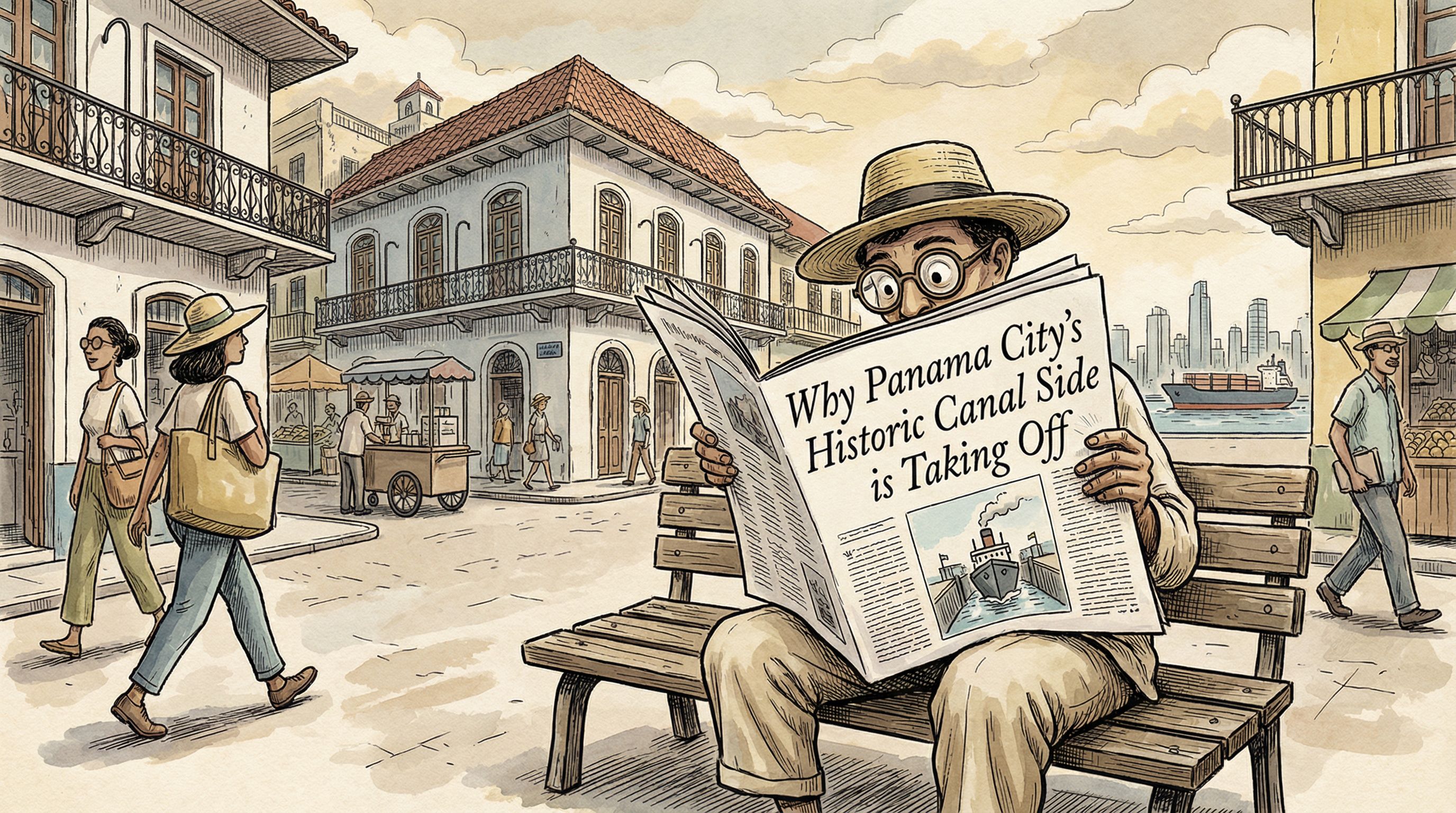
Discover why Panama City's Canal Side, including Casco Viejo and the historic district, is becoming the city's most sought-after area as tourism grows.
The Three Slices of Panama City
In an earlier post we talked about why Panama City’s historic district is growing out from its Colonial Casco Viejo and Here we’ll zoom out one more level to look at why the side of Panama City that abuts the Canal and includes the Historic District is becoming so popular and will continue to grow for many years to come. Panama City is long and thin, running East to West along the Pacific Ocean, roughly from Tocumen International Airport on the East, to the Panama Canal on the West. While the greater metropolitan area extends across the Canal into the distinct municipalities of Arrijan and Chorrera and North to San Miguelito, Panama City proper (Municipio de Panama) is the part in the middle.
Conceptually, it is perhaps helpful to divide Panama City into three general slices: East, Central and Canal. The East, running from the airport in to Costa del Este; Central, which includes Punta Pacifica, San Francisco, Punta Paitilla and the Banking District (Area Bancaria) and ends where Avenida Balboa terminates into the Historic District; and the Canal side, runs from the end of Avenida Balboa to the Panama Canal, and consists of the old Canal Zone (now known as the areas revertidas or “reverted areas”) and the historic neighborhoods of Casco Viejo, and Calidonia, among others.
From Business Boom to Waterfront Revival
Over the last twenty years, Panama has boomed as a global business hub. That intense focus on business drove a massive investment in office towers and business parks, starting in the Banking District and running Eastward towards the airport. Land reclamation projects created the neighborhoods of Punta Pacifica, Costa del Este and Santa Maria, which provided towers and gated communities to executives and their families.
At the same time, a massive effort was made to reclaim Panama City’s waterfront with a lineal public park called the Cinta Costera, which connected the Banking District to the Casco Viejo, and later on through an extension, to the Panama Canal. That investment in connectivity and public space coincided with the revitalization of Casco Viejo and a re-discovery of the Canal Zone by Panamanians, who were for the first time able to purchase and refurbish the classic Canal-style structures.
Why the Canal Side Is Poised for Growth
Today, the Canal Side of the city is poised for decades of continuous growth. Several factors:
The Canal Side is the city’s most historic and most nature-filled area. Almost all of the city’s history, charm and nature are on the Canal Side of the city. People come to see the Panama Canal, the Frank Ghery Museum of Bio-Diversity, the Colonial Casco Viejo and the Amador Causeway. They want to experience the rainforest, because Panama City is one of the few cities on earth that has a true rainforest within its city limits (Parque Metropolitano). The new cruise terminal which is at the end of Amador Causeay is So, unless someone comes to Panama City on business, there is little reason for a visitor to stay in the Banking District or East Side.
Even business travelers now have a reason to stay on the Historic Side. The new Amador Convention Center holds events up to 30,000 people. Inaugurated during the pandemic, it has taken time to build the book of business. But now conventions are starting to stack up.
Most of the country’s massive infrastructure spending over the next decade will be around the Canal. A new bridge is being built to connect the Historic Side to Arrijan, complementing the 100 year old “Bridge of the Americas”. At the same time, a tunnel is being dug under the Canal so the Metro can connect from the bedroom districts in Arrijan and Chorrera to the rest of the city through terminal in Albrook. Ports, pipelines and other infrastructure projects are planned along the Canal Zone.
The Historic Side of Panama City is the gateway to the interior mountains and beaches. Most people arrive in Panama at Tocumen Airport, but they reach the country’s beaches and interior through the domestic airport in Albrook, which is in the former Canal Zone. Or if they don’t fly, they start their drive to the beaches and mountains from the Historic Side of the city, across the bridge and into the interior.
Despite having almost all of the city’s tourism infrastructure, the Historic Side has few hotels. Panama City has approximately 17,000 hotel rooms. 15,000 of them are in the Banking District and East Side. Casco Viejo has approximately 500 rooms. And most of the balance are actually across the Canal in Veracruz. The disconnection between what visitors want to see and where they can sleep will create high demand for years to come.